Presence Is Optional: How the Ultra-Wealthy Are Redefining Status Through Digital-Only Membership
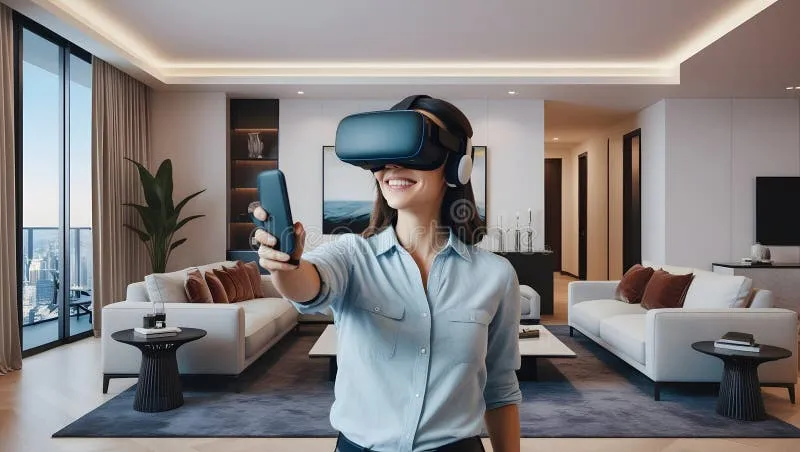
Photo: luxury virtual reality lounge high-end digital experience wealthy lifestyle technology, via thumbs.dreamstime.com
There is a particular kind of freedom that only a certain tier of wealth can purchase: the freedom to simply not be there. Not in the sense of absence or disengagement, but in the more radical sense of full, meaningful participation without the requirement of physical presence. It is a freedom that, until recently, had no real expression within the world of elite membership culture.
That has changed.
Across the United States, a quietly expanding cohort of high-net-worth individuals — founders, fund managers, creative directors, and the quietly wealthy who prefer not to be named — are gravitating toward a new category of exclusive membership that demands nothing of their geography. These are invitation-only digital environments: metaverse gaming lounges with six-figure access tiers, private streaming platforms curated for audiences of fewer than a thousand, and encrypted virtual gathering spaces where conversations occur that would never be committed to a public forum.
The term that has begun circulating in the more candid corners of luxury consulting is "phantom membership" — and it may represent the most significant reimagining of elite access since the private club emerged in nineteenth-century America.
The Logistics of Luxury, Reconsidered
To appreciate why phantom membership has found such a receptive audience among the genuinely wealthy, it is necessary to understand the particular friction that traditional luxury venues impose on their most desirable members.
The irony of elite physical spaces is that the people most qualified to inhabit them are often the least able to do so on any consistent basis. A partner at a major private equity firm, a technology executive managing operations across multiple time zones, or a family office principal with residences on two coasts — these individuals are precisely the members that legacy clubs most want. They are also the members least likely to make consistent use of a dining room in Midtown Manhattan or a lounge in Beverly Hills.
The phantom membership model resolves this contradiction entirely. The experience travels with the member, accessible from a ranch in Wyoming, a hotel suite in Tokyo, or the back of a car moving through downtown Miami. The value proposition is not a physical space but a curated community — and communities, unlike dining rooms, do not require your physical presence to function.
What These Spaces Actually Offer
The category of digital-first VIP membership is broad enough to encompass a genuine range of experiences, and it would be a mistake to conflate them. The most rudimentary iterations — invitation-only Discord servers and private Telegram channels — represent the entry point of this ecosystem rather than its apex. What distinguishes the truly elite tier is a combination of production quality, curation rigor, and the caliber of the community itself.
At the more sophisticated end of the spectrum, phantom memberships offer access to environments that are genuinely immersive. Private metaverse gaming lounges — several of which operate with annual membership fees comparable to those of traditional social clubs — provide members with rendered spaces that are architecturally distinct, visually opulent, and governed by their own social protocols. Gaming within these environments is often incidental to the primary value, which is the conversation, the network, and the sense of belonging to something genuinely selective.
Invitation-only streaming platforms represent a different but equally compelling model. Rather than competing with Netflix or HBO on the basis of catalog size, these platforms compete on curation and community. A membership might provide access to a monthly private screening of a documentary before its public release, followed by a moderated conversation with the filmmaker — attended, virtually, by a hundred individuals whose names you would recognize from the business pages of major American publications. The content is secondary to the context.
Location Independence as Status Signal
Within the cultural vocabulary of American wealth, status signals have always been subject to revision. The conspicuous consumption of an earlier era — the yacht, the estate, the table at the right restaurant — has given way, among the most sophisticated cohort of the wealthy, to a preference for signals that are more subtle and more meaningful.
Location independence has emerged as one of the most powerful of these new signals. The ability to maintain full participation in an elite community from anywhere in the world communicates something that a physical address cannot: that your life is organized around your choices, not your obligations. That you are not tethered to a city because your club is there or your social calendar demands it, but because you have chosen to be.
Phantom membership, in this context, is not a concession to a busy schedule. It is a declaration of a particular kind of freedom — one that is, by definition, available only to those who have achieved a sufficient degree of financial and professional sovereignty to exercise it.
The Challenge to Physical Venues
The rise of digital-first elite membership has not gone unnoticed by the operators of traditional luxury venues, and the response has ranged from studied indifference to genuine strategic alarm.
The most candid conversations happening within the private club industry acknowledge a structural vulnerability: the members most valuable to a club's culture and reputation are increasingly the members most likely to find a phantom membership appealing. If a digital-first platform can offer a comparable sense of community and a superior sense of convenience, the case for maintaining an expensive physical membership becomes genuinely difficult to make.
Some institutions have responded by developing hybrid models — digital extensions of their physical offerings that allow members to engage with the community remotely. The results have been mixed. A digital extension of a physical club tends to feel like exactly what it is: an afterthought, grafted onto an infrastructure that was never designed to accommodate it.
The platforms that are genuinely succeeding in this space were built as digital-first environments from the outset. They understand that the architecture of a virtual space — its visual language, its social protocols, its access tiers — must be designed with the same intentionality as a physical room.
The Future of Elite Access
What phantom membership ultimately suggests is that the future of elite access is defined not by where you go, but by who you are among. The most exclusive rooms in America may soon have no walls — only the invisible but carefully maintained boundaries of a community that knows precisely who it wants inside.
For TOKABU VIP members who have already embraced the logic of digital-first luxury, this trajectory will feel familiar. The platforms and experiences that define genuine elite access in the years ahead will be those that understand presence not as a physical fact but as a quality of engagement — and that have built their communities accordingly.